Written by EVEC Academy volunteer.
Every summer we watch Greek forests burn and Greek beaches fill with plastic, and feel there is nothing we can do. There is. Environmental volunteering in Greece is open to almost every age, and most of it starts with one free afternoon.
Here are nine real ways to help, sorted by age group. Each one says what you would actually do and who benefits.
Teenagers (13–17): Start With Your School or Your Family
At this age, the safest and easiest options are run by schools or done with a parent. An adult is always in charge.
1. Join your school’s Eco-Schools team. The Eco-Schools network is coordinated in Greece by the Hellenic Society for the Protection of Nature, the country’s oldest national environmental NGO. Around 1,400 schools have taken part. Students run projects on waste, water, energy or nature, guided by a teacher. Schools that do well earn the international Green Flag. Who benefits: your school uses less and wastes less, and younger pupils learn by watching you. If your school is not a member, ask a teacher to sign up.
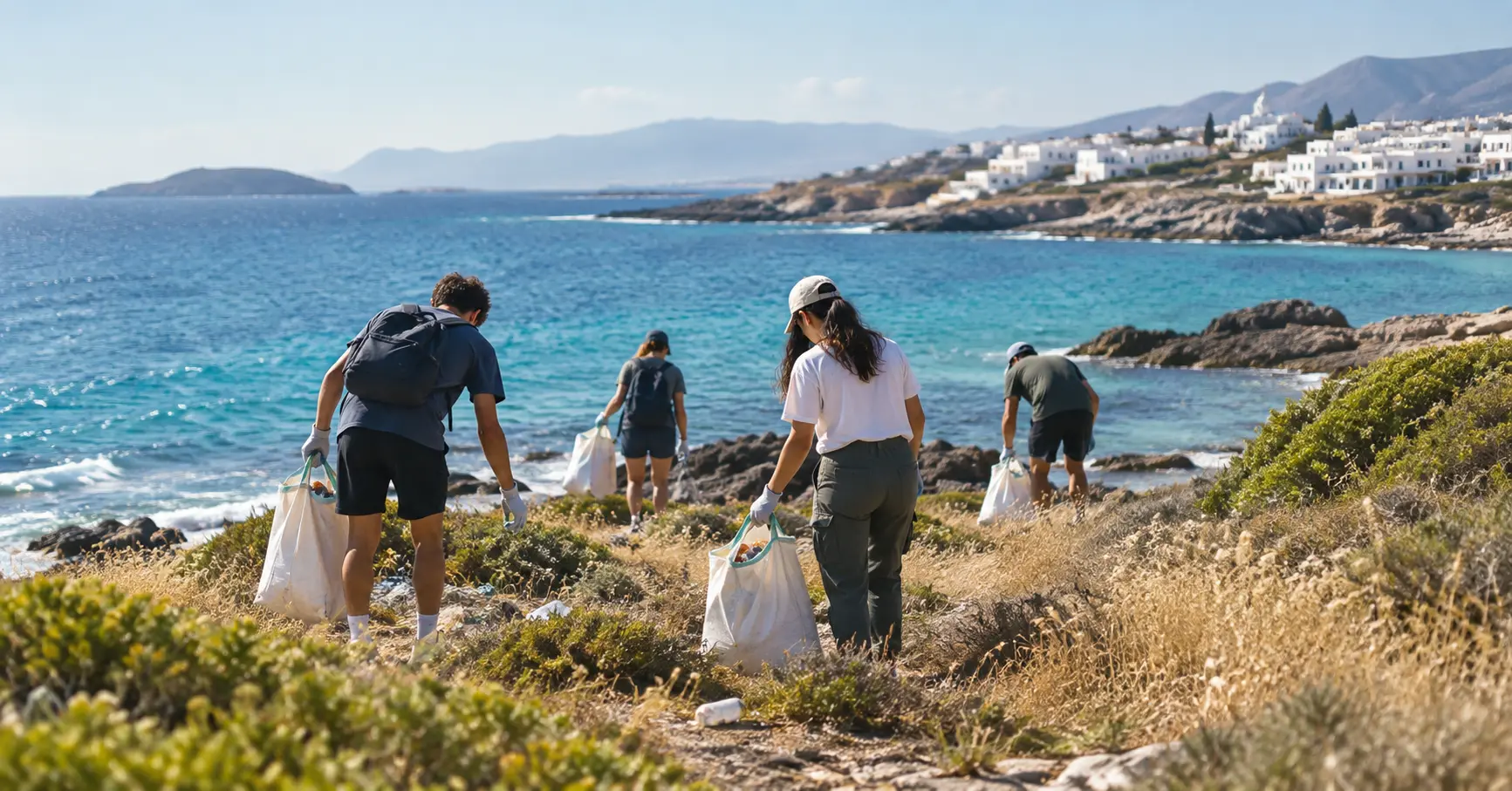
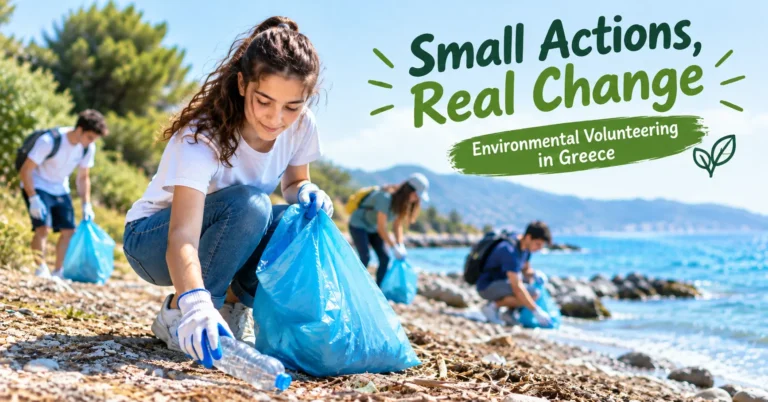
2. Do an autumn beach clean-up with HELMEPA. Every autumn, HELMEPA coordinates the International Coastal Cleanup in Greece. Its clean-ups are open to students, parents and teachers. Volunteers do more than pick up litter. They count and record what they find, following international protocols, so scientists can trace where marine litter comes from. In 2025, HELMEPA organised more than 500 clean-ups with over 24,000 volunteers. Who benefits: sea turtles, birds and fish, and everyone who swims at that beach next summer.
3. Plant trees with your family. The environmental non-profit We4all runs open planting days, many of them in areas burned by wildfires, such as Attica and North Evia. Families with young children have joined its big plantings. Who benefits: burned hillsides get new trees, which hold the soil and slowly bring back shade and wildlife.
University Students: Go Deeper, Build Skills
4. Protect sea turtles with ARCHELON. ARCHELON, the Sea Turtle Protection Society of Greece, needs volunteers on nesting beaches in the Peloponnese, Zakynthos and Crete, and at its Rescue Centre in Glyfada. Volunteers record and protect nests, care for injured turtles and talk to beach visitors. You must be at least 18, speak good English and commit to at least 4 weeks of fieldwork. Who benefits: one of the Mediterranean’s most important loggerhead populations. In 2025 the teams protected more than 10,000 nests. ARCHELON also holds a European Solidarity Corps Quality Label. That programme is for people aged 18–30 and is done in person, not online.
5. Join a WWF Greece reforestation or beach action. Fill in the WWF Greece volunteer form and you will be invited to actions such as replanting burned parts of Sounion National Park, or the “Adopt a beach” programme. WWF provides the tools and materials. Who benefits: protected areas recover faster, and you learn how restoration really works.
6. Fix instead of throwing away. Recycling is good, but repairing is better. In Athens, the social enterprise ΕΠΑΝΕΚΚΙΝΗΣΙΣ collects old computers, trains volunteers to repair them, recycles parts that cannot be saved and gives the computers free to school IT labs (read more on synAthina). In Patras, the group “Ανακυκλώνω στην Πηγή” created Greece’s first Repair Café, where volunteers help people fix their own broken items. Who benefits: less electronic waste, and schools and families who could not afford new equipment.
Adults: Lead, Protect, Commit
7. Become a volunteer firefighter. The Hellenic Fire Service accepts volunteers aged 18–55. Applications go to your nearest fire station between 1 July and 30 September each year. Basic training lasts 120 hours, from November to February. Who benefits: villages and forests, especially where professional stations are far away.
8. Join a local forest-fire protection group. Many towns have volunteer groups that patrol forests in summer and help with prevention. Through a programme with partners, WWF Greece has equipped about 2,000 volunteers from 50 such groups and trained more than 500. Who benefits: fires are spotted earlier, when they are still small.
9. Adopt a beach or organise a clean-up day. With HELMEPA, a group can adopt a beach (currently in Attica) for 3 years and clean and monitor it every season. Each spring, the Let’s Do It Greece campaign gives any group, school or municipality the tools to organise its own action on the same nationwide day. Who benefits: your neighbourhood, and the children who see adults taking care of it.
What You Get Back
Environmental volunteering teaches real skills: teamwork, scientific recording, first aid and planning. You meet people who care about the same things. And it looks strong on a CV or a university or European Solidarity Corps application.
Your Next Step
Start this month. The autumn beach clean-up season is open now. Visit HELMEPA’s clean-up page, pick a beach near you and register a clean-up with your school, family or friends. One morning, a bag and a pair of gloves are enough to begin.
Sources